2011-06-17

108 Kilometres and 5 Pounds Later (Ottawa River Pathways Hybrid Epic Ride)

Well it has actually been a few years since I have done an Epic (Over 100 kilometre) Hybrid Ride and I have been wanting to find out just how long a ride encompassing both the western and eastern Ottawa River pathways would be, having rode both separately.

Click on Map to Enlarge

One of the things keeping me from doing this sooner was the lack of proper connectiveness between the two sections, which I have written about previously.
East and West: Two Solitudes - The Problems With The Ottawa River Pathway

The Ottawa River Pathway Two Solitudes: PostScript
Starting in Bridlewood I took the Trans-Canada Trail through the Greenbelt joining the Ottawa River pathway at the Andy Haydon water park. The western pathway route is an enjoyable ride along the Ottawa River on paved pathways with the opportunity for pit stops to eat and drink at Britannia and Westboro beaches.

The connection to the eastern section was not as bad as I expected. After the killer hill up the cliff by the locks you just take Murray Street to Sussex Drive and continue to the Rockcliffe Parkway and onto the eastern pathways. So I was fine, but anyone who is intimidated by riding on major heavy traffic roadways could be intimidated and even a bit frightened, and our pathway system should not force cyclists into those situations.

Once I reached the Rockcliffe Parkway I was back onto paved pathways leading to the pathways along the river.

Click on Map to Enlarge

For the ride east I took the paved upper pathway along the Rockcliffe Parkway that goes past the Aviation Museum and then rejoins the path along the River.

Once you hit Orleans you follow the streets a bit past the Résidence Saint-Louis following the bike route signs and then take the Petrie Island Pathway that ends at Trim Road, but you can continue down Trim Road to the island. Most of the Petrie Island pathway is brand new pavement except for the last portion that is gravel. The pathway goes past a number of what appear to be mountain bike trails crossing over it, that I have yet to check out.

On the way back I kept to the pathway closest to the river, which is primarily a hard-packed gravel surface. Both pathways are enjoyable and scenic.

Casual cyclists should be aware that after you leave the river pathway, the path along the Rockcliffe parkway goes along a cliff and narrows for a portion and that can be a bit concerning but really is no great problem.

Getting from Sussex Drive back to the western pathway was another matter. I should have done better advance planning for the trip back and I ended up darting across the road where St. Patrick joins Murray Street during a break in traffic to get back to the path down the cliff. A better route would have been to continue along Sussex Drive to the other side of Murray Street and then walk the bike along the sidewalk to the path down the cliff.

Click on Map to Enlarge

The biggest concern of the ride was the heat and probably a sign that I picked the wrong day for an Epic Ride. I have done long rides (60-70 km) on hot days and I have done over 100 km rides before but combing both was probably a bad idea and after the 90 km mark I was starting to feel the effects of heat exhaustion, but I managed to make it home without collapsing.

One of the problems of the pathway system (besides the lack of washroom facilities, particularly in the early and late season) is the shortage of drinking water facilities. There are very few water fountains on the route and the few that are there require you to almost swallow the fixture to get a drink, making it impossible to use them to refill a water bottle.

I was able to buy water from a vending machine at the Rockcliffe Yacht Club though. The multitude of Private Property and Members Only signs kept me from even thinking about asking them to refill my water bottle with tap water, I felt fortunate that they let me use their vending machine.

But all being said it was a great experience and I would do it again on a cooler day.

Overall stats:

Total Distance: 108 km
Time Moving: 5 Hrs, 40 Min
Average Speed 19 km/hr
Maximum Speed 36.3 km/hr

Weight Lost During Trip: 5 pounds (but I regained about 3 pounds by next morning after rehydrating, etc.)

2011-05-28

The NDP, The Quebec Question and 50% + 1

Much has been made of Jack Layton's "controversial" comments on a possible Quebec sovereignty referendum.

The fact is that it is a very rational and defensible position. Based on the closest precedent, the entry of Newfoundland into Confederation, Quebec has followed the same rules, keep on holding referendums hoping to get the result you want with 50% + 1 required for passage. After all, otherwise we have a minority deciding Quebec's constitutional status.

That position, however, has it's problems. Other constitutional precedents require greater than 50% + 1 to make constitutional changes. As well, if support is that close the results of a referendum can vary from day to day.

That is why I tend to support requiring something like 60% support for such changes in constitutional arrangements, to ensure that the new constitutional arrangement will have continuing support. However that position also has it's flaws because in the case of, for example, a clear and continuous 55% support for sovereignty, the minority that opposes the change in status would effectively decide the fate of Quebec.

That is why the real focus needs to be on maintaining strong support for federalism in Quebec, support that has just recently been very effectively expressed by the people of Quebec in choosing a federalist social democratic party over a sovereignist one. We need to work on building and strengthening a strong federalist consensus in Quebec.

This will not be done by "giving Quebec whatever it wants" but by giving Quebec respect and building a strong Canadian community. This starts with recognizing Quebec's nationhood and it's right to decide it's own fate. Can we have a country within a country. It seems to work well enough for England, Scotland and Wales, within a unitary state. When have you ever heard Scots refer to themselves as "United Kingdomers" but their loyalty to both their country of Scotland and their nation state of the United Kingdom does not seem to be in conflict.

We have the best opportunity ever to set aside separatism in Quebec and build a strong Canada that includes Quebec. Quebec has spoken in the election and chosen federalism. All we have to do is work with the Quebecois to build a strong united Canada with them.

2011-05-27

Reflections on Mapping the South March Highlands Kanata Lakes Trails

For purposes of simplicity, although both trail systems are within the South March Highlands, I will refer to these trails, across from the Goulbourn Forced Road (GFR) parking lot, as the KL trails and the ones in the Conservation Forest as the SMH trails.

On Wednesday (May 25, 2011) I started my latest mapping project of what mountain bikers refer to as the Kanata Lakes trails, to distinguish them from the trails within the South March Highlands Conservation Forest. I do this either with a sense of history or a sense of optimism because these trails are located in Phase 7 of the KNL/Urbandale Destruction and are planned to be destroyed along with the forest and geology they are part of, to be replaced with yet another ticky tacky suburban subdivision.

Need I say one more time that losing this land and these trails will be a real tragedy, and indeed the Terry Fox Drive extension (routed over the least environmentally friendly route after public consultations indicated environmental factors should be the first priority in route selection) has already had a devastating effect on the natural and trail connectedness in the South March Highlands. Nevertheless as we fight to save what is left we should enjoy it for as long as we can and hopefully this trail map, when completed, will contribute to that.

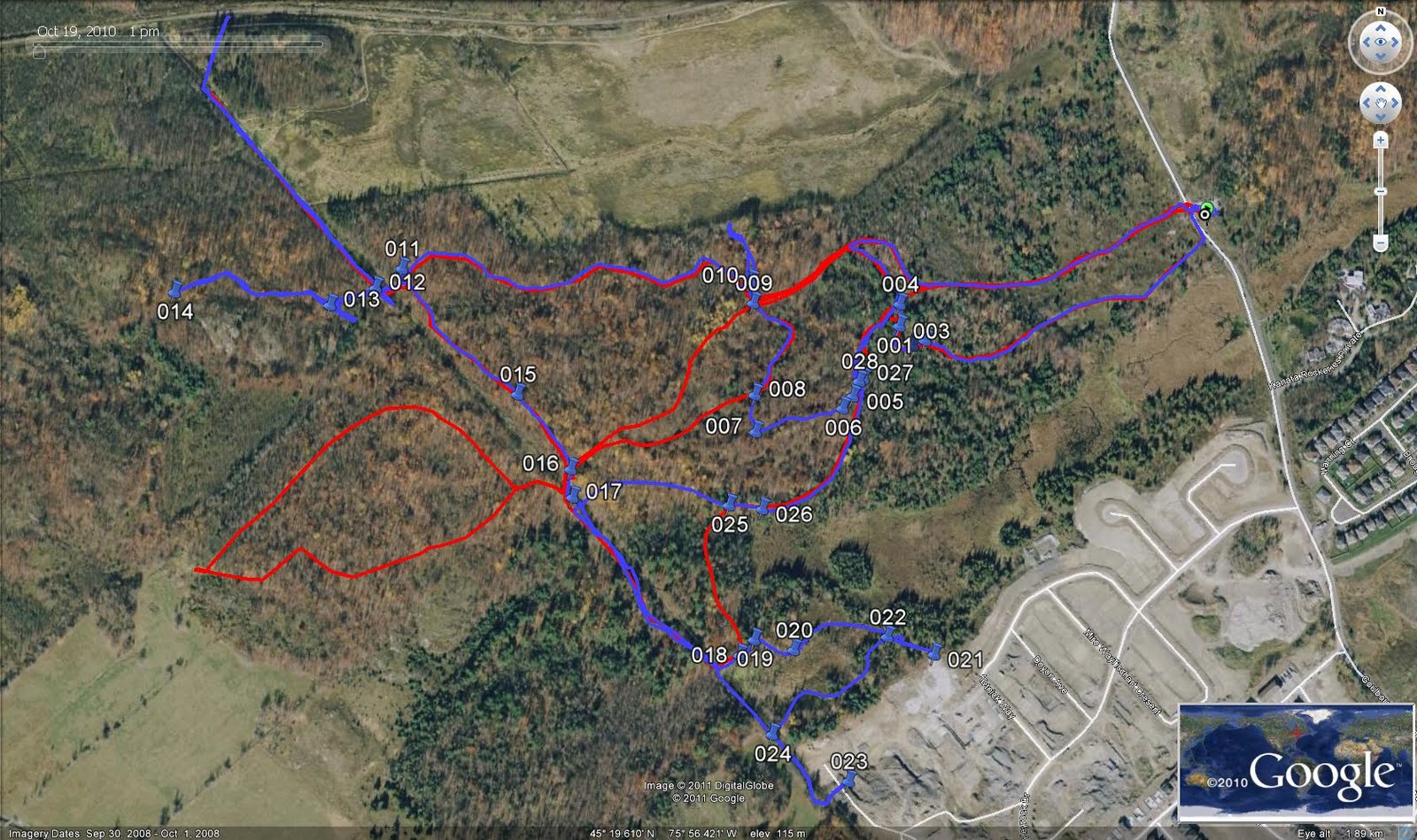
As with any mapping exercise I start I quickly discover the trail system is more complicated than I thought and includes more trails than on any existing map. So this is going to take a few rides to complete. At the moment I have tracks from this ride (blue) and another from last summer (red) on the very preliminary map below.

click on image to enlarge

As there did not appear to be any visible trail left at the old Kizell Pond signpost, I thought I would go in from the "Race Track Entrance" (that is not the entrance right across from the parking lot, but a bit south of it where you go "through" a couple of rocks) and see if I could work my way out to the signpost.

I never did get there but I did follow the hydro cut all the way to it's southeast end and discovered it ends in the Kizell Pond Subdivision. In the process I discovered a little loop around part of Kizell Pond, that might provide a pleasant route for short nature hikes with easy access. That was the first time I followed the hydro cut all the way to that end.

I also followed the hydro cut all the way to the northwest end where it ends at the Terry Fox Drive extension close to where it used to cross the rail line. As there was construction going on, and operating equipment right in my route to the other side, I was not able to confirm if you can access the other side. Depending on the gulley along the rail line you should be able to cross Terry Fox Drive at the rail line (traffic permitting) and connect to the rest of the trails.

The other interesting thing I discovered was another open section of trail (blue) west of the hydro cut on "The Dark Side", in addition to the section (red) I discovered open last summer. "The Dark Side" was private land that was fenced in and biking was prohibited on. Some of it is now city land but the status of these sections would require a very careful map comparison/overlay to determine. Both of these sections end at the new Terry Fox Drive extension.

The rest of my mapping experience consisted of following the usual KL trails including one offshoot that leads to a big open field where you can see the rail line across on the other side. If you follow the preliminary map above with these descriptions you should be able to see where much of what I am talking about is.

So why is this land and these trails so important. Very briefly, the South March Highlands is the most bio-diverse area in Ottawa and we are very fortunate to have such an area within our city and so close to the urban area. But, being surrounded by urban land puts its ecological integrity under great stress and if we continue to develop important pieces of it not only do we reduce its size but we increase the outside stresses on the land. We are close to the point of it's losing it's ecological integrity.

But this post is about the trail system and the KL trails have their own character distinct from the SMH trails. For mountain biking much of these trails are at an easier level and more open to riding by beginners. The terrain differences also make these trails much better suited to cross-country skiing than the SMH trails, which are better suited to snowshoeing. The two trail systems complement each other very well and are part of one interconnected ecological system, even with Terry Fox Drive running through the heart of them.

There is one distinct difference between the two systems. The KL trails are older and most were built by hikers and cross-country skiers while many of the SMH trails were by built by mountain bikers and are being maintained by them. It is very obvious that the SMH trails are much more sustainable than the KL trails. If we are successful in saving the KL trails there will need to be a review of the trails, which can probably be done as part of the City of Ottawa - OMBA (Ottawa Mountain Bike Association) joint stewardship agreement that is expected to be signed soon. Much work will need to be done to bring them up to OMBA standards. possibly including rerouting or closing some sections of trail.

But for now I hope to just finish mapping the trails so that we know what is there and can all enjoy the wonderful experience of being in this forest that we all hope to enjoy forever.

Now if we could just get the decision makers to spend a day in this wonderful forest.

2011-05-19

Obama Gets it Right on Palestine

President Obama understands what I wrote three and a half years ago, that ending the Israeli Palestinian conflict depends on recognizing that "the solution essentially comes down to understanding the most and least that each side can accept".

We could argue forever whether the State of Israel should have been created the way it was but, as most Palestinians have come to accept, that is a historical fact that is simply not going to change. It has been a huge and difficult step for the Palestinians to accept that, after all it was their land that was stolen from them. But come to accept it they have. That is the most they can be expected to accept. The least they can be expected to accept is to have their own Palestinian State and have Israel give back the land they stole since the creation of the State of Israel with no exceptions. The original boundaries must be restored, including the status of Jerusalem at the time Israel was created.

The least that Israel can be expected to accept is to have their right to exist accepted by the international community, including Palestinians and Arab states. The most they can be expected to give up is all the land they stole after the creation of the state of Israel, a not unreasonable expectation.
Hard line Israelis, and their even harder line supporters in the United States, may not want to accept anything other than a solution dictated by Israel but the rest of the world knows, and President Obama understands, that Middle East Peace will require compromise, and while the hard liners may not want peace the rest of the world does.

2011-05-02

REMEMBER

It's Time To Vote

2011-05-01

Best CN Cycle for CHEO/Tour Nortel Yet

Well surprisingly this was the best year ever that I have had riding in the Tour Nortel or CN Cycle for CHEO. I've been fighting something off all week and was not even sure when I got up this morning if I could do it but decided once I was on my bike everything would be OK.

click image to enlarge

After iffy forecasts the weather turned out great, even if it started out cool. The route was very scenic, even if it did turn out to have some long hills with the wind against us. My longest training ride was 57 km and my best average training speed was 19.5 km/hr so I figured if I could do at least 18 km/hr I would be fine. It turned out I had my best time yet of 20.5 km/hr average with a maximum speed of 41.5 km/hr (downhill with the wind behind me).

click image to enlarge

A good time was had by all I am sure.

2011-04-23

It's Time

You don't have to choose between tweedle dumb and tweedle dumber


2011-04-20

Minority Governments for Dummies (and Tory PMs)

  • the voters elect the House of Commons to govern
  • the leader of the current government (the government before the election) has the right to meet the House and attempt to gain its confidence, however usually the party with the most seats gets the first opportunity to be Prime Minister and lead the government
  • responsible government requires that the Prime Minister maintains the confidence of the House of Commons to govern
  • a minority government cannot survive if it attempts to govern as if it had a majority
  • a Prime Minister cannot bully the House of Commons into supporting him by threatening an election if he doesn't get his way
  • there is always a Prime Minister in waiting willing to attempt to gain and maintain the confidence of the House if the Prime Minister cannot or is not not willing to
  • a government is legitimate, and only legitimate, if it has the confidence of the House of Commons
  • minority governments can work if a Prime Minister recognizes it is the House of Commons that was elected to govern, not him by divine right
  • minority governments can implement, and have implemented, important measures including Old Age Pensions, Medicare and the Canada Pension Plan
Minority Governments in Canada | Mapleleafweb.com

2011-04-14

South March Highlands and Carp Hills - NCC Role in Protecting Natural Environment Lands: Beyond The Greenbelt

This post is also being sent via email to National Capital Commission CEO Marie Lemay
( Marie.Lemay@ncc-ccn.ca )

click on map to enlarge

The National Capital Commission has recently published maps identifying natural environment lands within the National Capital Region as part of it's concept plans for the Greenbelt Master Plan Review.

Interestingly, none of the lands identified are within the urban boundary of the City of Ottawa. It is, as if by definition, the NCC has decided that lands within the urban boundary have no environmental value.

Of course, in the case of the South March Highlands we know that is not true. There are lands within the urban boundary and within SMH that are even zoned Environmental Protection, and others that should be, and were, but were rezoned for reasons that had nothing to do with their environmental value.

There are undoubtedly other lands of environmental value within the Ottawa urban boundary as well. It is unfortunate that the NCC has decided they are unworthy of recognition.

One of the things I noticed right away from the NCC map was the identification of one large natural environment area comprising the South March Highlands and the Carp Hills. I just recently had the opportunity to hike some of the Carp Hills land (some of which the City of Ottawa apparently owns) and was quite impressed with it's natural environment value. In examining the City Zoning Map it became obvious that a significant amount of the land identified by the NCC as natural environment is not zoned Environmental Protection (not that that guarantees it will be protected). I expect this applies to other natural environment lands identified on the NCC map.

So now that the NCC has identified these lands as natural environment lands what are they going to do about it. They will do a great disservice to the community if all they accomplish is creating a false belief within the public that these lands are actually protected from development.

Now that they have raised the public's expectations the NCC must fulfil their responsibilities and meet those expectations and take the necessary measures, whether by means of purchase/expropriation or some form of ironclad federal protection that neither landowners, developers nor the OMB can overturn, to protect these lands from development. The public expects and deserves no less.

click on map to enlarge

2011-04-12

The Debate: Canadian Values Win

The most interesting thing I noticed about the debate was where all the leaders, or at least all of the federalist leaders, agreed.

These were on what I would consider to be the most basic of Canadian values, but values that many of us suspect are not dear to the heart of Stephen Harper, yet he provided vigorous defences of them - public health care and multiculturalism.

It speaks well to their broad support among Canadians that not even Stephen Harper would publicly oppose them knowing it would be political suicide.

The other issues I particularly noticed were the ones that were only raised by Jack Layton, electoral reform, particularly proportional representation and aboriginal issues.

Jack also gets some points for language, being the only leader to use the term ""hashtag" in the debate and "commentariat" during the post debate scrum.

2011-04-06

Ottawa's Green Bin Program - Time for City Council to Lead

An Open Letter to Ottawa City Council and Residents
RE: Residential Solid Waste Service Level Review Recommendations


This open letter is being posted on my blog, The Fifth Column ( http://the5thc.blogspot.com/ ) and being sent via email to the the following city councillors:
Jim.Watson@ottawa.ca
Allan.Hubley@ottawa.ca
Marianne.Wilkinson@ottawa.ca
David.Chernushenko@ottawa.ca


There is a time for politicians to follow and a time for politicians to lead. If one of our goals is to make Ottawa a Green City then Ottawa City Council will have to provide leadership to make it happen.

We will never become a Green City if City Council punishes those that are doing the right thing and rewards those that are part of the problem.

There have been issues raised regarding animals getting into Green Bins and maggots in Green Bins. I have never had these issues with our Green Bin, probably because the Green Bins are more secure than most garbage cans. However, I have had them with our garbage containers, but very few times over 30 years living in Ottawa. The fact is that the colour of the container has nothing to do with these problems.

These problems relate to organic waste so the best way to eliminate or reduce them is to increase how often the organic waste is picked up and that is what the recommended plan does.

So the solution is really simple. Residents just need to use the system the way it is designed. Recyclables go into the Blue and Black Bins, organics into the Green Bin and what little is left, mainly non-recyclable excessive packaging, goes into the garbage (which could be picked up monthly as far as I am concerned).

As far as using the Green Bin being more costly or complicated, it need not be. We do not need to listen to those that see this as an opportunity to sell us more products like specialized bags that contradict the very idea behind the Green Bin of eliminating and reducing unnecessary waste. Nor do we need to listen to the media that think they are being helpful by suggesting all sorts of complicated solutions to non-existing problems.

We do not use a bag for our kitchen container, indeed rather than the container that came with the Green Bin we use a kitchen garbage can without any liner and dump it into the Green Bin when full. This is more convenient as it is larger and needs dumping less often. We rinse it clean about once a week.

The Green Bin would probably not need lining either but we have cats and find the kitty litter does stick to the plastic so we line it with old newspapers. I put newspapers along the bottom and up the sides a bit and then all along the sides from the top to cover the inside completely. I did have to slightly compromise my "not buy anything new" policy by using a very small amount of masking tape to help hold the newspaper to the sides of the bin at the top. That was a ten minute job the first time and under five minutes each time since and it does not need to be done each week as often the lining remains in the bin after dumping.


You can also use outdoor composting bags by cutting them down a few inches but that again requires more unnecessary consumption and waste.

It is very clear that there really should not be any controversy here. All that is required is for people to use the waste reduction and collection system the way it is designed to be used.

Unless the City wants to abandon any hope of being a Green City, City Council must support those that are doing the right thing, not those that are part of the problem.


To read more about my views on the Green Bin Program please see The Fifth Column: Why Sabotage The Green Bin Program

2011-03-31

Do You Really Support Stephen Harper

Are you a lifelong conservative, perhaps going back to the Progressive Conservative Party. Do you assume Stephen Harper represents you because he is the leader of the Conservative Party.

Find out which party really represents your views by taking the Vote Compass survey.

You might be surprised by the results. But don't assume a Liberal Party bias, as many have. I am a lifelong NDP supporter and it told me the Green Party best represented my views - no Liberal bias there.

To find out how your views really match the federal parties and leaders go through the analysis portion of Vote Compass and see how your answers match the parties' policies. You will probably be surprised how out of touch Stephen Harper's Reformatories are with your views and traditional Canadian conservative values.

Check it out and decide for yourself who best represents your political views.

Learn more about Vote Compass here.

2011-03-30

Tweedle Dumb and Tweedle Dumber Pushing for Two Party System

It started with Ignatieff joining Harper's anti-coalition bandwagon, the common message being that the big boys don't share power with the little guys and it's extended to the push for a debate between just Harper and Ignatieff because they think that they lead the only two parties that really matter.

It is clear that the fight for a more democratic Canada and a more representative electoral system that recognizes that voters have the right to choose who governs them (not just the right to go through the motions of choosing between two establishment parties) will have be a hard fought battle led by the voters themselves.

It starts with refusing to give any party a majority, even if our flawed system is designed to give parties a majority of seats with under 40% of votes.

This election is about democracy.

2011-03-28

Map of The Kanata Lakes 40% Travesty

click on map for full size image

This map, released by the City of Ottawa, makes it abundantly clear just how much of a travesty the so-called Kanata Lakes 40% agreement is. Indeed it was clearly a public relations exercise that the City of Kanata and Regional Municipality of Ottawa Carleton had to be complicit with, or totally incompetent to be taken in by.

We have an agreement that allows land within the environmentally sensitive South March Highlands to be developed in exchange for "saving" a golf course outside of the South March Highlands (according to the map of SMH in the 2008 Brunton report). When you see just how much of the 40% "greenspace" is taken up by the golf course you realize just how much of a sell-out to the developers this agreement is.

And as we look at the map of the golf course it becomes clear that it was designed to have as many houses bordering on it as possible in order to increase their sales and price. It was clearly all part of a marketing scheme and had nothing to do with saving greenspace or environmentally sensitive land.

This makes the whole process, and the agreement, totally illegitimate and for this reason it is totally legitimate and necessary for the public to continue to fight this and not too late for public authorities to finally do the right thing and save the environmentally important lands northwest of the Goulbourn Forced Road (KNL phases 7 & 8) from destruction by Urbandale/KNL.

2011-03-27

The Coalition is Dead - Someone Tell Stephen Harper

The idea of a coalition government is dead for the simple reason that it is not in Michael Ignatieff's political interest to enter into a coalition that would require him to share power. Although it is in his political interest not to contradict Stephen Harper's coalition fear mongering but to leave the impression he is opposed to a coalition because of it's supposed illegitimacy.

Of course, if coalitions were illegitimate the governments of most western democracies, including that of the United Kingdom that our government is modelled on, would be illegitimate.

It is clearly to the political advantage of the Liberals to reject a coalition and try to leave the impression that the only way to defeat the Harper Reformatories is to vote for the Liberals. That is not true of course. Strategically speaking the best way to defeat the Harper Reformatories is to vote for the candidate in your constituency that has the best chance of defeating the Conservative candidate.

If the Conservatives do not receive a majority, but receive another minority and face the House of Commons and attempt to govern as if they had a majority (as they have in the previous Parliament) they will face certain defeat, either on their Throne Speech or Budget, leaving the Governor General bound by precedent to ask the Leader of the Official Opposition if he believes he can form a government. Michael Ignatieff would most certainly reply yes, and as long as his government acted responsibly, presenting measures that a majority of the House of Commons could support, he would be able to govern.

The situation was different when the last coalition proposal was put together because the constitutional precedents become less clear and certain the longer a government is in power and it was deemed advisable to present the Governor General with a very clear indication that a stable government was possible because, despite Stephen Harper's irrational ravings, coalition governments are much more stable than minority governments.

So despite Stephen Harper's desperate fear mongering (over something there is no reason to fear) the Liberals will not enter into a coalition simply because it is not in their political interest to do so.

2011-03-26

Too Smart For Canada

I am not a big fan of Michael Ignatieff but this is brilliant.


2011-03-24

Democracy Election

While thousands worldwide sacrifice their lives for the right to free elections Canadians complain about having one.

That is not to say there are no reasons for some Canadians not to want an election. Certainly if you support the Reformatories you have it pretty good right now. With a minority in the House of Commons (and an even smaller minority of public support) they have control of the government with a majority opposition that lets them govern as if they have a majority. On the other hand if you voted for the opposition parties you twice elected a majority of Members of Parliament (representing a majority of the public) that has refused to exercise the democratic power the people gave them and lets the Reformatories govern as if they represented the majority. So what is the point of doing it again.

If there is going to be another election it must be about democracy and bringing the government back under the control of the majority of the House of Commons and establishing a more democratic electoral and governing process.

If the opposition parties are going to force can election they must pledge to form a government that represents a majority of the House of Commons and a majority of voters.

Why are they so scared to say that. Just because Stephen Harper thinks the concept of the majority of the legislature governing, as it does in the vast majority of western democratic countries, is illegitimate does not mean the opposition parties should accept that absurdity. Coalition is not a dirty word. Political parties and Members of Parliament actually co-operating to provide a democratic majority government is a good thing. It is certainly better and more democratic than the current tyranny of the minority that currently governs this country.

Perhaps the voters are collectively smarter than we give them credit for and have discovered that the concentration of power in any one party, no matter who it may be, may actually be bad for democracy. If the people want power to be spread amongst many parties rather than concentrated within one that is their democratic right and it is the responsibility of the political parties to co-operate and provide the people with the government they have chosen.

But we need more than just regime change.

I call upon all political parties and candidates that consider themselves to be progressive (and that can include Members of parties that have removed progressive from their name) to pledge to join together after the election in a democratic coalition pledged to improve democracy in Canada.

The number one priority of such a government should be to establish a more democratic electoral and governing process in Canada.

The first thing such a government should do is initiate the Parliamentary processes, including public consultations, to consider and implement the following measures, along with others that they decide are necessary, to improve democracy in Canada:

- eliminate the use of government advertising for promoting government polices and restrict it to information on how to access government programs and benefits

- ensure the independence of all Officers of Parliament, including the Chief Electoral Officer

- ensure and increase the House of Commons right to and ability to access government information, including provisions for access to confidential and classified information on an in camera basis

- establish a fixed election date every four years with the House being dissolved earlier only when a government cannot be formed that has the support of a majority of the House of Commons (to be effective after the next election)

- strengthen measures to ensure the fairness of elections so that financial resources, rather than individual capabilities and policies, do not determine the outcome of elections

- reform the electoral process into a more representative and democratic process where the number of seats a party has represents the number of votes they receive nation wide, while retaining constituency representation, paying particular attention to the systems of proportional representation used in western European countries
Following the implementation of these measures the government should then resign to allow a new election to be held under the new more democratic and representative electoral process and such an election should include a referendum on whether voters want the Senate to be abolished or reformed.

Establishing real democracy in Canada only takes, what sometimes seems to be the rarest of all things, political will. Do we, as politicians, voters, and a nation, have it.

2011-03-23

Democracy Under Attack

Democracy is clearly under attack in Canada by those who always claim to be it's defenders, and led by the man who would be dictator.

Stephen Harper wants all the trappings of Presidential Power without the checks and balances of the separation of powers in the American system, nor the inconveniences of accountability to Parliament in our system of responsible government.

Pierre Trudeau is reported to have said that Members of Parliament are nobodies off Parliament Hill. Stephen Harper would have them be nobodies on Parliament Hill. Stephen Harper believes that the Prime Minister's Office should be the seat of all power, not Parliament.

His contempt for Parliament has been shown by his multiple prorogations to avoid facing it, his government's withholding information from and lying to the House of Commons and it's committees, its cabinet ministers doctoring official documents from public servants, and the list goes on. Indeed his government is the first in Canadian history to be formally found in Contempt of Parliament.

But Stephen Harper not only has contempt for Parliament, but contempt for the voters and the courts. His attitude to his party being found guilty of violating the laws designed to ensure that we have fair elections is to dismiss it as unimportant and simply a difference of opinion on minor regulations. Of course Stephen Harper believes the market should rule everything and that voting should be like shopping - whoever has the most money to wage the best marketing campaign, whether deceptive or not (or fought with the taxpayers money using government advertising), should get the most customers votes.

But then again, Stephen Harper does not believe that the Members of Parliament elected by the people should choose who forms the government. He seems to honestly believe there is something undemocratic about the majority of elected Members of Parliament forming a government and that only a government of the largest minority is legitimate, seemingly unaware of the principles of our Parliamentary system or the practices of the overwhelming majority of democratic countries in the world.

But the problem goes beyond the Reformatories and Stephen Harper. Unlike the vast majority of democratic countries in the world our electoral system results in a House of Commons that rarely, if ever, reflects the way the population as a whole votes in terms of party representation.

Unlike most countries in the world that have proportional representation systems Canadian elections usually result in one party having a majority of seats in the House of Commons without receiving a majority of votes in the election. This is praised because it is seen to be more efficient to have power concentrated in one party. Most other democratic countries of the world seem to manage fine with coalition governments that actually reflect how the people voted and require the different parties to co-operate and reflect the wishes of the voters.

Our system however does not just concentrate power in the hands of the party with the largest number of seats (in some cases the party with the most seats may receive less total votes than another party) but tends to concentrate power in the hands of the Prime Minister, as we have seen too well with the current Canadian regime.

This attack on democracy goes beyond contempt for Parliament and the voters - but extends to a contempt for the whole idea of government, the whole idea of the people acting collectively for their collective interests.

The Reformatories, and right wingers everywhere, like to spout the rhetoric of the evils of big government and the evils of taxation. They do not believe that the people should act collectively or spend their money collectively. They have very good reasons for being against government. When citizens act and spend through their governments they act on a one person one vote basis. When citizens act and spend individually they, in effect, act on a one dollar one vote basis, thus concentrating power in those with the most wealth.

That is the reason right wingers do not like government - because it takes power away from the wealthy and transfers it to the people.

2011-02-23

The Struggle to Protect The South March Highlands Simplified

What is the Most Important Thing to Know About the South March Highlands

The key things to know about the South March Highlands are:

• it is a popular all year recreation destination for people from all over Ottawa and an international mountain biking destination

• while, within the City of Ottawa, it feels like wilderness when you are in it

• it is a candidate Area of Natural and Scientific Interest (ANSI)

• it is the most biodiverse area within Ottawa

• it is the home to a huge number of species of flora and fauna, including many endangered and threatened species

• it contains old growth forests and provincially significant wetlands

• it includes Canadian Shield geology and other significant geological features

• it is the site of numerous pre-contact (pre-European) archaeological sites and may be eligible for UN World Heritage Site status

• it has been declared sacred by Algonquin First Nations chiefs and elders

• the area considered the most environmentally significant, Trillium Woods, is under great ecological threat because KNL's development plans will cut it off from the rest of the city-owned Conservation Forest

• while the privately owned land north of the city-owned Conservation Forest is zoned Environmental Protection, that has been proven not to be enough to protect the land from the threat of development
But the most important thing that you need to know about the South March Highlands is that it is one ecosystem and harm to one part of it harms all of it and if you want to protect part of it you must protect all of it.

2011-02-18

The Next Generation of The First Peoples Looks at The South March Highlands

'Sacred Dollars' (Documentary by Aurora Finkle)


Since the tender age of 9 yrs old, Aurora Finkle has had an incredible and impressive musical career. Having won the 2000 dollar grand prize at 08's National Aboriginal Day 'We Got Talent' competition in Ottawa, Aurora has performed at numerous events. She has performed in front of the Senate, Grand Hall in the Museum of Civilization, Pow-wows, Music festivals, Gala's, Conferences as well as having appeared on numerous Television, Radio shows and Newspapers. To top it off...last year she released her debut album entitled after her middle name 'Jade'. Coming from a musical family, Aurora is amazingly comfortable on stage and can quickly command the attention of the entire audience singing everything from Jazz, Folk, Blues, Celtic. Aurora also acknowledges her aboriginal ancestory through Traditional Native songs and is a member of a local women's handdrum group. Aurora is now 11 (12 now) yrs old and continues to perform regularly. (source)


2011-02-04

Stand Up and Be Counted for the South March Highlands

Do you support saving the South March Highlands from destruction.

If so, you are probably aware of the fact that Internet trolls, the media and even Ottawa Mayor Jim Watson seem to be doing all they can to foster a myth that this is a NIMBY issue, supported only be people who live near the Beaver Pond Forest.

However the truth is that much more than just the Beaver Pond Forest is at stake. Indeed a whole ecosystem, that has been identified as an Area of Natural & Scientific Interest (ANSI), that includes provincially significant wetlands, many endangered or threatened species and the greatest amount of biodiversity in the Ottawa region - the South March Highlands, is threatened.

And the truth is that support for saving this ecosystem, comes from thousands of people in all parts of Ottawa, and throughout Canada and even internationally.

If you want to show your support for saving the South March Highlands to the world, and the media, please send your photos to savesmhphotos@gmail.com along with your name and where you live. Photos should preferably be a height of 800 pixels, but I can easily resize them (better larger than smaller).

We would like to show the broad range of support across Ottawa and nationally and internationally so please indicate your neighbourhood if within Ottawa, eg. Bridlewood, Katimavik, The Glebe, Centretown, etc. (unless you feel uncomfortable doing so). If you live outside Ottawa please indicate your city or town and province or country. And if you do live near the South March Highlands, please send your photo in. We want to reflect reality, not distort it.

You can view the photos of people who support saving the South March Highlands at South March Highlands Supporters Photos (Coalition to Protect the South March Highlands).

You can stand up and be counted along with them.

click on map to see larger image

Other Coalition to Protect The South March Highlands Sites

Save Ottawa's South March Highlands

Ottawa's Great Forest

I want to save the land North of Beaver Pond Park in Kanata Ontario Facebook Page

SMH (SouthMarch) on Twitter

2011-02-03

Mayor Jimmy and Mayor Larry: So Similar, Yet Different

Mayor Jimmy came into office an a platform of accepting Mayor Larry's position on the two big issues of the day Lansdowne Park and Light Rail, as well as having the Mayor's Office draw up the draft budget. Only his style was apparently different.

Ironically, neither one of them understands what leadership is. Mayor Larry seemed to think it was bossership, acting as a CEO and giving orders. Mayor Jimmy seems to think it is avoiding confrontation and issues - that running the city is about good administration, not politics, although, ironically, it was Mayor Larry who ran on the "vote for me because I'm not a politician" platform in his first campaign.

Mayor Larry was a big idea man, he wanted to turn the City into a Corporation, something Mayor Jimmy has done a better job of with behind the scenes executive decision making only rubber stamped in public with none of the annoying public debate and confrontation that democracy entails.

One thing, however, that no one could accuse Mayor Larry of was cowardice. The man had guts. He tried to break the OC Transpo workers union - a stupid but gutsy thing to do.

Mayor Jimmy, on the other hand, likes to run away from controversial issues and the public that elected him. When it comes to the battle to protect the South March Highlands he wants to pretend it doesn't exist claiming the previous Council dealt with the issue, when the last thing the previous Council did was defer a motion forward to the new Council.

Mayor Jimmy refuses to meet with the proponents of saving the forest ecosystem, even when they are right at his doorstep (on several occasions), does not answer emails and reportedly diverts emails to SPAM without even having anyone read them. We can only surmise that he does not want to know what the public thinks. But of course he knows very well what the public thinks.

He simply wants to pretend there is nothing he can do so that he can avoid having to choose between the public that votes for him and the developers who fund his election campaigns.

It is time for Mayor Jimmy to show some leadership and try to find a solution for the people of Ottawa rather than running away from the public and the issue.

2011-02-01

Bearing Witness at the Beaver Pond Forest

Sometimes, as a social responsibility, people have to bear witness to unbearable things, such as the killing of people in state-sanctioned executions. Thankfully in Canada we have progressed to a state where we are more civilized than that.

However, in Kanata this week citizens take up the responsibility for witnessing just as uncivilized an act as they bear witness to the state-sanctioned execution of the Beaver Pond Forest, except that this execution is neither, quick, painless, nor humane.

They have my gratitude for taking on this responsibility which I believe would be too painful for me to bear.


2011-01-27

An Atheist Visits The Sacred Fire

I am an atheist. I do not believe in god or mythical beings, nor do I believe in organized religion. I think of myself as a physical and intellectual being and not as a spiritual one.

So what does "sacred" mean to me. That is a good question for I do not usually think of things in that manner. But if I was to think of anything as "sacred" it would be the land, and in particular, land in it's natural state.

I love being in the forest, and while many safety experts recommend against it, I love being in the forest alone. I always tell people that they should not be afraid of being alone in the bush because you are never alone in the bush. But I do not fear the animals in the bush for I mean them no harm.

So for me it was important to visit the Sacred Fire to pay my respects to the forest and the land that we all want to protect and it was a particular honour to be smudged by Algonquin Medicine Man Ron “Big Bear” Goddard.

The Sacred Fire represents the prayers and hopes of many peoples. Indeed, as far as all involved know, this is the first time that non-aboriginals have been given the responsibility, and honour of tending a Sacred Fire. This is indeed a very important milestone in the development of the Canadian multicultural mosaic. And it represents what the land means to all of us.

Not that there is not some "culture clash". The media have expressed an interest in Sundays Day of Prayer for the Land, and want to know when the protest is and when the leaders will be speaking. But to the Algonquin this is not a protest and it is not a day for the leaders but a day for the people. This, of course makes it much more significant, but not so good for "sound bytes"

Indeed recent reports indicate that people all across Canada and across the world will be taking some time Sunday to participate in the Day of Prayer for the Land.

I invite all of you who do not quite understand what this is all about or the significance of it to spend some time in the forest and to spend some time sitting by the Sacred Fire.

2011-01-24

Pray For The Land

(please click on above image to enlarge and read)

Statement by the Coalition to Protect the South March Highlands

Attached is a download link to the Pray for the Land announcement planned for this Sunday, Jan 30, in the South March Highlands [announcement appears above this statement]. The current outlook, which we are still working hard to prevent, will have tree clearing begin in Beaver Pond Forest on Jan 31. Tree clearing has already occurred on Richardson Ridge prior to our OMB appeal being heard.

It is apparent that the City’s infrastructure approvals staff intend to push this subdivision thru regardless of how many rules they have to bend/break.

The provincial government is acting like an inert bowl of jelly. Despite irrefutable evidence of provincially significant archaeology, the Ministry of Culture has done nothing. Despite the fact that the City of Ottawa lacks the authority to approve the mass killing of wildlife, the Minister of Natural Resources has done nothing. Despite the fact that the planned subdivision will illegally divert water from one watershed to another, the Minister of Environment has done nothing. Despite the fact that the most-biodiverse area in Ottawa is being clear-cut, in his own back-yard, the Premier of Ontario has done nothing.

Two area MPs, Gordon O’Connor and Paul Dewar, have asked the NCC to show leadership and step in. The NCC has the archaeologists and natural environment assessment resources that the city lacks. Yet the NCC has done nothing and the Minister of the Justice continues to ignore the illegality of a mass killing of wildlife, the Minister of Indian & Northern Affairs continues to ignore the constitutional duty to consult with all First Nations who have stepped forward in protest, and the Minister of the Environment continues to ignore a travesty that is playing out within 20 minutes of Parliament Hill.

Thousands of letters have been sent and yet we still have to ask “WHERE ARE OUR LEADERS?”

It’s time to make our voices visible. It’s time to make our prayers heard by all.

A large turnout will be important to help bring this issue into the consciousness of the thick heads of politicians at all 3 levels of government. Please advise your distribution lists. We will be sending out a media advisory as well as Action notice to our list.

Thanks for your continued support to Protect the South March Highlands.

2011-01-23

Algonquin Chiefs Statement re proposed development in the South March Highlands (Beaver Pond Forest)

This is posted at the request of the Chiefs

January 22, 2011

Kwey Kwey,

We are writing to you on behalf of several Algonquin communities who remain outside of the comprehensive land claims process and thus have not been consulted about the proposed development in the South March Highlands. The Beaver Pond Forest is one of the only remaining stands of forest in southern Ontario that contains old growth trees. Most of the original forests that existed here have been lost because of unsustainable logging practices and settlement of Indigenous homelands by Europeans and their descendants. As retired Chief Robert Lovelace has brought forward, Philemon Wright was the beginning of sustained British Settler colonialism in the Ottawa Valley. Soon after his arrival in 1803, he was caught attempting to cut down an entire sugar bush by a group of Algonquin people. At that time, they stopped him and questioned his actions and why they had not been consulted about the changes he was in the process of bringing to their homeland. Wright told them that he had authority to do so by the Colonial Office. We now know that this was a lie and that Wright had no such authority from any British officials, and even if he had, he did not have the authority from the Original People who have the ultimate responsibility for maintaining balanced relationships within this homeland. Wright did not consult with Algonquin people who would be impacted by his development. In fact when confronted, he dismissed Algonquin concerns about the forest and their relationships with the forest as superstition. He informed them that they needed to “be sensible” and abandon their way of life in favour of the “gift of civilization” that came with English settlement and development.

Wrightʼs actions were a direct violation of the Proclamation of 1763 which guaranteed Algonquin people that third party interests such as developers would be prevented from appropriating Algonquin lands without those lands being first sold to the official British government operating through the Colonial Office. Algonquin people received this guarantee by John Johnson, then Indian Agent, who signed a copy of the Proclamation and gave it to them to keep in their possession. Historical evidence shows that Algonquin people carried this with them and mentioned it in various petitions to the British government concerning Algonquin lands.

Two hundred and eight years later, we are very aware as Algonquin people that these ancestors were right to question Wright and his actions that day. In that period, the great forests were still mostly intact; there was little damage from mining, or forestry on the land, and there were few toxins or contaminants in the soil and water. All of that degradation has happened as a result of settlement that came subsequent to Wright. He and his sons built all of the “colonization” roads in and around Ottawa, which aided the intense settlement in the area after the War of 1812 by British Loyalists. This settlement across what is now southern Ontario and Quebec led to the establishment of a resource extraction industry, which fueled the economic and political development of Canada as a nationstate. In a contemporary sense, Canadaʼs economy is still based upon resource extractions. This is why Canada, under the Conservative government, had refused to ratify the Declaration on the Rights of Indigenous Peoples. To do so was seen as a possible threat to the economic and political longevity of Canada as a nation-state. Even now the acceptance of the Declaration by Canada happened only with “conditions” attached to it that would prevent Indigenous communities from articulating the rights that are embedded in international law. Canada continues to maintain its colonial legacy with Algonquin people so that it can maintain its status as a nation-state.

The Algonquin homeland, the Kiji Sibi, has suffered great ecological degradation as a result of settler colonialism over the past two hundred years. The land and waterscapes have been so altered that we are not sure our ancestors would recognize it any longer. Their fears about the actions of developers such as Wright have been realized across the expanse of our homeland. Not to mention in every other Indigenous homeland on the planet. Settler colonialism has also had catastrophic impacts on our identity as Algonquin people. Not just because of the Indian Act and residential schools, but because of the specific ways that these policies and legislation have impacted our minds, bodies, and spirits. As a result of this destructive colonial process we struggle to know ourselves as people and we struggle to restore in ourselves the comprehensive understanding of our relationships within our homeland that our ancestors enjoyed and which Wright witnessed.

While we have begun the journey to reclaim our humanity and our dignity as distinct human beings, it is a hard journey filled with continual obstacles because of the colonial consciousness that has been created and perpetuated in Canada. That consciousness relegates the Natural World to a subservient position to human beings where those spiritual beings are seen as nothing more than resources that can be extracted for the economic and political benefit of Canada. Every day we struggle as Algonquin people to find comprehensive ways to reconnect ourselves culturally and spiritually to those spiritual beings in our homeland. Mining, clear-cutting, and numerous other development projects impact our ability as people to make that reconnection and to sustain it into the future. “We are the land and the land is us”. Many Elders and Knowledge Holders have said this in all parts of the World, and it is true for the Original People of the Kiji Sibi.

The Beaver Pond Forest contains over ten thousand years of history and relationships in our homeland that has survived settler colonialism. It is a place where we can go as human beings and connect (or reconnect) with our ancestors and the spiritual beings that still exist there. It is a place where we can gather as people and heal from the destructive processes we have had to endure over the past four hundred years. It has been argued as well by various anthropologists and archaeologists that this forest is a national heritage site that should be protected from development because of this very history and the added bond that settlers have developed with this landscape.

Many people now see the Algonquin homeland as their home and also want it to be protected. It has also been noted by various scientists that Beaver Pond Forest has hundreds of diverse species with respect to animals, birds, amphibians, insects, trees, plants, to name just a few categories that will be directly impacted by the proposed development. For Algonquin people, there is the additional knowledge that comes from Pimaadiziwin that recognizes these beings as spiritual beings who have specific roles and responsibilities that must be maintained within the forest. Our responsibilities and their responsibilities working together maintain the ecological diversity and longevity of the Natural World. The compounded loss of these spiritual beings within our homeland as well as the continued colonization of Algonquin people jeopardizes the entire ecosystem. As human beings, it is our responsibility to make sure that we act in balanced ways so that these spiritual beings can maintain their responsibilities. In other words, it is not the Natural World that needs to be managed; it is the interactions of human beings with the Natural World that need to be managed. When we think about development today as Algonquin people, we look at it comprehensively based on the fact that our homeland has already had 200 years of impacts as a result of settler colonialism. Given this reality, we have to consider the compounded impacts on lands and watersheds from any proposed project. We also have to consider the social and cultural impacts on our identity as people because of the ways in which development and resource extractions impact our relationships with the Natural World and thus our ability to develop positive identity into the future as distinct human beings.

These complex relationships make it vitally important that all Algonquin people be consulted so that we can discuss and decide for ourselves whether or not a particular project should go forward. These decisions must be based upon more than western scientific paradigms. Western scientific thought within our homeland is very young in its development and thus limited when it comes to true comprehension. Our knowledge system and ways of understanding the Natural World, however, are much older because it emerged over thousands of years through ongoing direct relationships with all components of the Natural World. This process enabled Algonquin communities to develop complex social and political structures that guided both individual and collective behavior in ways that promoted balance and the continued sustainability of the entire ecosystem.

Our ability to maintain these responsibilities within our homeland are continually under assault by the Provinces of Ontario and Quebec which have assumed control of our lands as a result of The BNA Act and Canadian Confederation. British and then Canadian Law created an artificial border that continues to separate Algonquin people from each other and to limit our ability to work together to maintain our relationships and responsibilities within our homeland. Algonquin people in what is now Quebec are never consulted about development or resource extractions within what is now Ontario, and we are never consulted about development or resource extractions within the Algonquin homeland in Quebec. We are forced to deal with Ontario and they are forced to deal with Quebec. The Algonquin people on both sides of this colonial border need to be able to come together to discuss and make decisions about all development and resource extractions throughout the entirety of our territory. These decisions need to be made based upon our collective directive based upon our customary law that was developed by our ancestors. We need to come together in a united fashion to reassume jurisdiction within our entire homeland collectively based upon our own principles set out to us in Algonquin Law.

The history of the present land clams process in Ontario is evidence of this urgent need. When issues around development or resource extractions emerge, the province makes very limited attempts to consult with the AOO (Algonquins of Ontario). The title of the organization working with the province and federal government to extinguish Algonquin title and jurisdiction is misleading, however, because the AOO does not represent all Algonquin people in Ontario. There are other Algonquin communities who choose to remain outside the comprehensive land claims process because they consider it to be fraudulent and not in keeping with Algonquin Law and the responsibilities that we have to maintain balanced relationships within our homeland. For twenty years community leaders outside the claims process have consistently reminded the province and the federal government that there is a duty to consult with all Algonquin people not just the communities who sit at the claims table. As communities outside that process, we MUST be consulted about proposed development within our homeland. The AOO has shown through past actions that they cannot be trusted to represent the interests of all Algonquin people with respect to decisions about development and resource extractions. The AOO has not and does not consult with us about their decisions. Therefore their interests are not ours, and do not take the place of free, prior and informed consent for development projects or resource extractions within the Algonquin homeland. This fact became evident to us as we struggled through the uranium exploration project and resulting conflict beginning in 2006. Our struggle to stop that development was undermined by the AOO who signed an agreement to allow uranium development on Ardoch lands without any consultation whatsoever having taken place with Ardoch leadership. In fact the province refused to consult with Ardoch leadership about the project and instead helped to facilitate the deal between the AOO and FVC. We consider this to be a betrayal of Ardoch Algonquin people by the AOO and also the thousands of local residents who worked tirelessly to support our efforts. It is also a betrayal of the duty that the province and the federal government has to us as the Original Peoples of this homeland.

The truth we came to realize is that the current claims process with the AOO does not represent the majority of Algonquin people and therefore cannot take the place of comprehensive consultation with all Algonquin people. In each of the areas, claimed by the table, and represented by an ANR (Algonquin Nation Representative) there are other Algonquin communities who have chosen not to participate in the process to extinguish Algonquin title and jurisdiction. This does not mean they have given up their right to be consulted, each community outside of the process has asked for direct consultation on various issues, but the Crown has refused to fulfill its fiduciary responsibility. Unlike what happened in previous historical treaty processes, this particular table has not been particularly successful in hiding the true colonial nature of the process or the ongoing documented opposition to it by a majority of Algonquin people, including those in Quebec. As communities, we continue to fight against it and to bring attention to the fact that we are not surrendering our interests as Algonquin communities in our homeland. Algonquin Law is still in effect in our homeland and we remind both the Province of Ontario and Canada that you have a fiduciary responsibility to consult with us as Algonquin communities about any development that has been proposed to happen. Consultation with the AOO is not consultation with our communities.

We have not been consulted about this project as Algonquin people and we demand that you to begin that process now. This is our homeland and we have no other place that we can connect to as human beings. We will utilize Algonquin Law and international law to protect our homeland as we have been instructed to do within our Original Instructions and by our Elders and Knowledge Holders. We call on you now to honour the responsibility that you have under the Proclamation of 1763, the Constitution Act of 1982, and the Declaration on the Rights of Indigenous Peoples. We do not support this development and call on you now to stop it and to meet with us to discuss the larger issue of Algonquin title, rights and jurisdiction.

We also call on the Algonquin people and communities presently working within the AOO process to take a step back and consider the impacts of this process on our people and on the Natural World. We urge you to abandon participation in the present claims process and return to Algonquin Law and work with us to develop a collective unified Nation that can work locally, regionally, nationally, and internationally to restore autonomy within our homeland.

Miigwech,

Paula Sherman- on behalf of:

Chief Paul Lamothe: Ottawa Algonquin First Nation
P.O. Box 198, Wendover, ON. K0A 3K0
613-673-2217: pelamothe@videotron.ca

Chief Grant Tysick: Kinounchepirini Algonquin First Nation
3689 B-Line Road, Pembroke, ON. K8A 6W7
granttysick@hotmail.com

Chiefs, Mireille Lapointe or Paula Sherman:
Kapishkawandemin Family Headʼs Council, Ardoch Algonquin First Nation
1045 Canoe Path, Ardoch, ON. K0H 1C0
613-273-3530: Mireille Lapointe, mimikwe@gmail.com
705-750-7490: Paula Sherman, omamikwe@bell.blackberry.net

Chiefs, Melinda Turcotte or Melissa Graber:
Pasapkedjiwanong Algonquin First Nation
1585 Pinery Rd., Smiths Falls, ON., K7A 4S7.
Melinda Turcotte: kiwe@rideau.net
Melissa Graber: algonquin.1@live.ca
algonquins.of.pasapkedjiwanong@gmail.com

2011-01-21

Will the Beaver Pond Forest Eve of Destruction lead to the South March Highlands Dawn of Correction


"Make no mistake about it. Those trees will come down."


Those words from City of Ottawa senior legal counsel Tim Marc, in late July 2010, make it clear that the City never intended any real consultation with the community or with any Algonquin First Nations representatives. Indeed nothing has changed since the election as far as developers determining city policies is concerned, other than perhaps an even more pro-developer City Council.

How naive do they think the public is that they expect them to believe their "pretty pleases" to the developer mean anything after they have given them full speed ahead approval to clear cut and blast the forest away.

So where do we go from here. We know the City has no intention to stand up to KNL (Urbandale/Richcraft) even in the face of documented flaws in the environmental assessment process, inadequate and inappropriate storm water management plans and alleged outright illegalities, not to mention the lack of a proper response to the archaeological information provided to them and the complete lack of constitutionally required consultations with all First Nations with an interest in and concerns about the land.

We still hold out hope that someone, perhaps another sovereign level of government, will have the political will to step in and save the Beaver Pond Forest before it is destroyed.

Cutting has now been delayed till February - time to write your federal and provincial representatives and the NCC.

Regardless of the outcome of the fight for the Beaver Pond Forest the fight to save the rest of the South March Highlands continues.

We must all recognize that it is not only the KNL (Urbandale/Richcraft) lands that are threatened, and it is not only the privately owned lands currently zoned Environmental Protection that are potentially threatened.

The South March Highlands are one ecosystem and one habitat for flora and fauna. If all the lands surrounding the city owned South March Highlands Conservation Forest are destroyed the ecological integrity of the protected lands will be under great stress and undoubtedly will be affected negatively. Trillium Woods, identified by the City as the most environmentally significant zone, will be under the greatest stress if destruction is allowed to continue as planned, as it is only connected to the rest of the forest by a narrow connecting strip with Terry Fox Drive running through it.

The smaller an environmentally protected zone is, the least chance it has of surviving as anything other than an urban park. That is why the 40% agreement narrow strips of land are meaningless, as is "Marianne's Pathway", essentially an urban pathway the cost of which was twice as much protected land elsewhere.

I say to the city of Ottawa do not let what happened to the lands south of the Conservation Forest happen to the lands north of it. Act immediately while these lands are zoned Environmental Protection (and valued accordingly) to bring them into public ownership and protection before it is too late, using the City's expropriation powers, if necessary. Even former councillor and fiscal conservative Gord Hunter recommended that.

As for the KNL (Urbandale/Richcraft) lands south of the Conservation Forest, they are the most important to save as they provide the connection between Trillium Woods and the rest of the Conservation Forest. But we know that we cannot depend on the City to save them.

That is why we have to get the message out to our provincial and federal representatives that these lands are special. Anyone who has spent time in them or has studied then knows this. And these lands are not just environmentally significant but culturally significant to the Algonquin Peoples containing archeological sites and have been declared sacred by their Elders.

The National Capital Commission is currently studying whether to add the South March Highlands to the Greenbelt as part of their Review of the Greenbelt Master Plan, but the Final Master Plan is not scheduled to be completed till Fall 2012. This may be too late for significant parts of the South March Highlands.

Everyone must urge the NCC to expedite the decision making process on adding these lands to the Greenbelt. Write or email NCC CEO Marie Lemay and other federal government representatives and tell them how much the South March Highlands means to you and how important it is to save all of it as a complete ecosystem.

Meanwhile we have to buy time for the NCC and other levels of government to act. We must do what we can to stop the destruction of the Beaver Pond Forest and to stop KNL (Urbandale/Richcraft) from moving on to the next phases of destruction.

Usually when house buyers purchase houses, they just see a housing development. They do not know what was there before. This will not be so for the Beaver Pond Forest. Potential house buyers will know that they are buying houses on destroyed sacred land. And they will know that if they buy these houses KNL (Urbandale/Richcraft) will move on to destroy more land to build more houses. This fact alone can have a huge impact on preventing KNL (Urbandale/Richcraft) from moving ahead to further phases of destruction.

It is time to let our elected leaders know that it is never too late to do the right thing.


Further resources on the South March Highlands

South March Highlands Overview

Save Ottawa's South March Highlands

Ottawa's Great Forest

I want to save the land North of Beaver Pond Park in Kanata Ontario Facebook Group

The Fifth Column SMH posts

The Fifth Column SMH Management Plan posts

Virtual Nonsense (Paul Renaud) SMH posts

South March Highlands Advocacy

South March Highlands Stewardship Plan

Brunton 2004 Report

Brunton 2008 Report


2011-01-16

Working Class Hero - Rest In Peace

Hated by some members of the public, André Cornellier always put his members first - a true Working Class Hero


Ottawa Citizen Obituary

2011-01-15

RESPECT

City of Ottawa Consultations with Algonquin First Nations re South March Highlands

It is not the purpose of this post to suggest to the Algonquin how they should represent their people in consultations with the City of Ottawa, but rather, as an Ottawa resident, to suggest to the City of Ottawa that it should deal with respect with the Algonquin in representing our interests.


The Ottawa Citizen reports:

OTTAWA — The planned construction on the South March Highlands can’t begin until the city has held consultations with Eastern Ontario Algonquins, a native group says in a new letter to Mayor Jim Watson.
...

The letter from the Kichesipirini Algonquin First Nation, a non-status band under the Indian Act, says the land is in the group’s traditional territory and so they have a right to a say in how it’s used.
...

After a recent discussion with the Algonquins of Ontario, [Deputy city manager] Schepers said, the city acted as a go-between with KNL, seeking to have the tree-cutting put off until the Algonquins can review the studies of the land, a process she understands could take till the end of the month.
There is more than a constitutional requirement to consult here, there is also a matter of respect. Respect for the First Nations of these lands would mean the city would not simply "seek" to have the clear cutting delayed but would refuse to allow it until meaningful consultations were completed.

Respect would mean that they City would follow the recommendations of the Aboriginal sub-committee to the Arts, Heritage & Culture Advisory Committee to Ottawa's City Council which states
BE IT RESOLVED THAT:

1. The City undertakes a comprehensive and meaningful consultation with all Aboriginal peoples who wish to participate regardless of status;

2. The current and planned site preparation and alteration activities, including tree-clearing, in the South March Highlands for the Richardson Ridge, Uniform, and KNL subdivisions be immediately halted pending consultation with the Indigenous people of the Ottawa River Watershed;

3. That the City request the assistance of the National Capital Commission who have a licensed archaeologist on staff;

4. That the City takes a leadership role in assuring that a full and credible archaeological survey is performed independent of the third party interest of developers.

5. That such an archaeological survey encompass the entirety of the South March Highlands.

6. That this be set in place as soon as possible.
Respect for the archaeological heritage of the First Nations means no clear cutting or other work on the lands would occur until proper studies can be done when the forest is clear of snow and the ground no longer frozen.

But respect for this heritage means much more. These are not just isolated archaeological sites, they occur within a context. Identifying them, fencing them off and putting up plaques does not represent respect. These sites are within the context of the forest and destroying the forest context and replacing it with "ticky tacky" does not show respect for the First Nations heritage or the forest.

It is time for everyone involved, the developers and all levels of government to show respect.

Respect for the Community
Respect for the First Nations
Respect For the Land